Summer Solstice 2025: Circles of Motion

Summer Solstice occurs on Friday, June 20th, 2025 at 7:41 pm Pacific Time. It is the peak of light in the year—the longest day and the shortest night. Even if it’s not always the peak of greening and growing.

Here in the Pacific Northwest, we’ve been nonstop blooming since early February—snowdrops, heather, the many bulbs mom planted, the calendula that overwintered, marsh marigold, bleeding heart, the rhododendrons, the overwintered chamomile, western and eastern Solomon’s seal, lilacs, apple and pear trees, salal, salmonberry, and thimbleberry bushes, oxeye daisies, wallflower, chives, Astrantia, roses, Pacific Ninebark, foxglove, oriental poppy, and pond lilies! (And I know I missed some others…)

This year, I’m more than ever aware of the circle of summer coming around again…all this blooming, over a few months leading us right into the Summer Solstice again. I love that I can still rely on the earth to grow again, to flower again, to create food, and beauty yet again! Like last year and the year before, and many before that.

But it’s happening early this year. And that worries me. Climate change is disrupting the seasonal circles.

As I write this, we have 2 inches less rain that we should have at this time of the year. It’s been a very dry spring. I have had to start watering the perennials a whole month earlier than last year. And my big water tank (270 gallons) is almost empty already…

Amidst all the flowers and greening, I am afraid and deeply sad about the disruption and damage we are causing the earth. The breaking up of the natural order, the natural circles of life.

This excerpt from Muscogee Joy Harjo’s Eagle Poem invites us into a way to be with this reality:

To pray you open your whole self
To sky, to earth, to sun, to moon
To one whole voice that is you.
And know there is more
That you can’t see, can’t hear;
Can’t know except in moments
Steadily growing, and in languages
That aren’t always sound but other
Circles of motion.

The seasons are circles of motion of the earth. The earth shows herself to me in flowers and greening this time of year, but there are so many circles and so much motion happening underground and invisibly all around.

How can I open my whole self in prayer so that I can participate more fully in these circles of motion? Certainly, by tending the earth, by loving and caring for the earth, by listening to and praising the earth, sun, sky, and moon…

I pray for sun and rain and care and rest, that the earth receives these in the right amounts so that she can bloom and thrive.

I pray and give thanks as I create food and medicine from the plants the earth offers freely. This is one of the ways I can commune–by receiving these gifts and allowing them to heal me and my family.

I wonder if the earth prays? Maybe as I do, tangibly—in the winter-spring in rain, in the spring-summer in greening and flowers, in the summer in sun, and in the fall in apples and pears and Fall harvest?

And as I pray or the earth prays, do we know ourselves as one voice? Does she know me as earth standing on two feet? Do I recognize her many forms and shapes as me? And tend her as I tend myself—feeding, watering, brushing, cleaning, loving?

I find grace in knowing that the earth is always here, carrying us through the seasons, more than we know or can see, in circles of motion. For now.

Spring Equinox 2025: In the Muck

In some places, this is the beginning of Spring, but where I live, it’s more like mid-Spring.

In Port Townsend, Washington we haven’t had enough rain yet—the winter didn’t bring the normal amount and Spring rains have not settled in with their regular pattern… Luckily, we still have time as Spring can last through “Junuary” around here!

Even so, there are quite a few places on the land that are mucky! Down by the compost bins at the bottom of the mulch beds, I could lose a garden clog if I’m not careful.

There is standing water near the comfrey circle that the native Ninebark and basket willow I planted are very happy to drink in.

The leafy bower path that winds by Green Woman and down into the young alders is also quite soft in many places.

And walking the forks path on the nearby DNR lands, I have to dance around and carefully pick my way through very muddy pathways.

I lived in Vermont for a few years in the 90’s, out a ways from town on dirt roads. I remember a Spring where I had to drive really fast in between the muddy ruts up a hill, just hoping I’d have enough speed to make it through before the muck sucked me in! There we had 3 seasons: Mud, Construction, and Winter!

It’s a sign that the earth cannot take in all the water quickly, which indicates to me that, with this water stored, we will have enough water to make it through our droughty summer… So, the mud is a healthy sign at this time of year.

This reminds me of our small garden pond. It’s pretty shallow—just a foot or so—and just below the water you can see the mud (silt, watered-down earth).

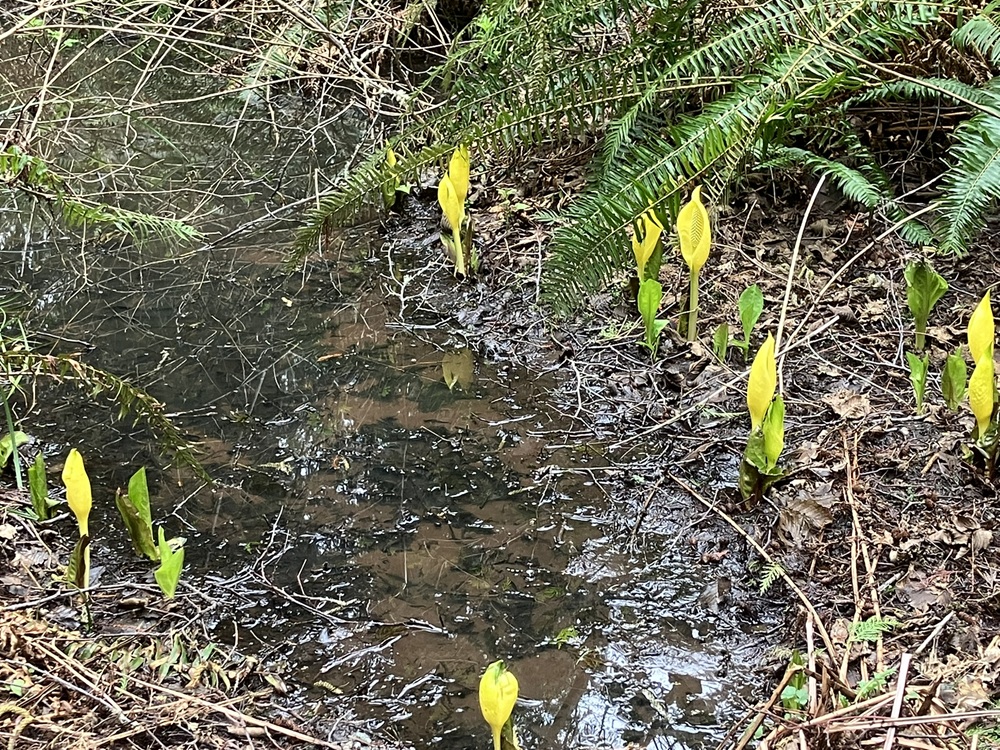
And right now, the skunk cabbage is popping up out of the mud at the bottom of the ravine path—that’s the picture at the top of this post.

Isn’t it amazing??

It will be up even farther when this is posted. I think they look like lanterns keeping vigil.

I wonder if remembering the lilies and skunk cabbage growing out of the muck can help me in these difficult political times.

Is it possible that just as we need to experience mud season to have a healthy earth, that we need to go through these times as a country to learn how to bloom and have a healthy society?

Maybe we can learn to be care-full of where we put our feet.

Maybe we can learn to trudge through the muck and keep going, maybe even dance?

Maybe we can watch for what is growing out of the mud and be reminded that the beautiful lantern or flower need the muck to grow.

Winter Solstice 2024–Breathing Room

Dave and I have an Advent ritual of reading a beautiful little book, All Creation Waits by Gayle Boss. Every day, it offers a story about a different animal and how this animal uses their innate knowing to adapt to the cold and dark of wintertime.

Even though we read it last year for Advent, too, the instinctual wisdom of each animal lands so deeply in me each time.

This winter, one of the messages I am working with is from Musk Rat.

Musk Rat’s physiology makes it possible for them to be a frigid-water swimmer all winter! Even when all is covered in snow and ice, Musk Rat can find plants to eat by diving deep down to the bottom of a body of water.

But even well-prepared by their amazing coat, Musk Rat gets cold after a while. So Musk Rat builds what’s called a “push up,” a pile of sticks that poke up from the water through the ice, so they can climb out of the water into this sheltered breathing room. Here Musk Rat can rest, regain their strength.

  • I sit in the nook and look out at the gardens. My favorite time is to sit and breathe while dusk is falling.
  • I light a special solstice candle and pause.
  • I sit by the woodstove and watch the flames.
  • I step outside and breathe in the crisp, cold air, looking around at the living earth, pausing from work.
  • I lie down and rest on the ground (inside since it’s so wet out!).
  • I sit or stand quietly outside and open my awareness.
  • I soak in the hot tub at dusk and sing songs to welcome the dark.

Especially since I spend so much time in front of a computer these days, I need to balance this with moments in the breathing room. And I love the idea that I am aligning with my innate inner winter wisdom by doing this.

This breathing room gives me a moment to align my bodysoul with the rhythms of the living earth.

The rhythm of slow.

The rhythm of cold.

The rhythm of rain and

long,

gray,

dark hours.

And if you’d like to step out into the great breathing room of the living earth, join me on December 21st for an outdoor Winter Solstice Celebration! Read more.

A new solstice song for you from my dear friend and Full Voice Trainer, Barbara McAfee:

Fall Equinox 2024–Lying Down

It marks the beginning of Autumn in the US, and in the Celtic calendar, which aligns more closely with where I live in the PNW now, it’s the midway point, with Lughnasadh in early August as the start.

Veggies and fruits are being harvested and finishing up ripening in the last warm rays of the sun.

The light is changing—more angled, shining later on the gardens, highlighting the coming darkness.

And the sun is rising later and setting earlier—I find it surprising to wake up in darkness again!

Nancy Paddock’s poem “Lie Down” is a wonderful call for this season:

Lie down with your belly to the ground,
like an old dog in the sun. Smell
the greenness of the cloverleaf, feel the damp
earth through your clothes, let an ant
wander the uncharted territory
of your skin. Lie down
with your belly to the ground. Melt into
the earth’s contours like a harmless snake.
All else is mere bravado.
Let your mind resolve itself
in a tangle of grass.
Lie down with your belly
to the ground, flat out, on ground level.
Prostrate yourself before the soil
you will someday enter.
Stop doing.
Stop judging, fearing, trying.
This is not dying, but the way to live
in a world of change and gravity.
Let go. Let your burdens drop.
Let your grief-charge bleed off
into the ground.
Lie down with your belly to the ground
and then rise up
with the earth still in you.

Now in Autumn, the busyness of summer is slowing and we are being invited, like the leaves on the trees, to drop, to return, to slow down, to lie down as we move closer to winter.

This happened with my pre-cervical cancer scare 10+ years ago. Receiving that diagnosis brought me right to ground and forced me to reorder my life to include more rest, more self-care, more lying down…

Or a client with a major depression who ended up needing mental health support in a hospital. She received a strong call to return to the ground of her being and to work on building a new way of body, heart, and mind in order to rise back up into living.

Like it did for me on retreat last month. I found myself captivated by a big old Doug Fir stump who was obviously returning to ground, very slowly.*

Sitting, praying, singing, grounding with this stump being.

Breathing and opening the fronds of my heart with the sword fern at theirs.

Dropping thoughts, over and over, into the earth.

Taking in all the life growing in and around.

It was raining steadily so I did not physically lie down on the earth, but I did with the rest of my bodysoul, allowing myself to dissolve with the rain into the ground, with the decaying life.

Letting go of trying to know, letting go of being separate, letting the ground, the stump being, and the forest hold me.

And when it was time, I rose up with the earth still in me to return to the human world… and then returned to practice with stump being again and again over the rest of the retreat.

* On retreat, all electronics were off and stashed, so I have no picture of this being to share.

Summer Solstice 2024–The Garden

If you’re local to Port Townsend, WA, please join the Summer Solstice Celebration at Quimper Unitarian Universalist Fellowship!

This time of year, the garden is coming into fullness. In summer, we tend to focus on all the flowers that are blossoming—and it’s amazing how flowers are coming into their own right now!

The roses began opening last week—the wild Nootka, the Red Rose I don’t know the name of, as well as the mature Floribunda bush mom planted years ago. And the Foxglove spires reach for the sky, their buds bursting into flowers as blooming energy travels up their stalks. The bright orange-red and the pink Poppies are smiling and the dusky white Astrantia is face-open to the sun. The Rhododendrons and the Korean Lilac are almost done, as well as some bolting, flowering Kale, Arugula, and Collards that I am still harvesting from overwintering in the veggie garden.

And so much more is still to come into flower as the weather continues to warm and the light is long!

It’s the natural unfolding of the plants’ inner instructions, for sure, but we can also look a little more widely at all the factors that help a garden to grow:

  • The space we clear for the plants,
  • The nutrients we add to the soil, be that mulch, compost, or specific amendments,
  • The work we do to clear the soil of impediments—removing rocks, slugs, rabbits, voles (all in my gardens), etc.,
  • The supplying of water and counting on enough sun and warmth,
  • The good wishes, prayers, and songs to feed their spirits.

Just like the blossoming of the plants, our blossoming is also supported by much-needed toil and loving attention. The conditions we create allow our inner and outer gardens to flourish and bloom.