Beyond Rightdoing and Wrongdoing

This is the 2nd of a 3-part series. Read the first.

Just choose Love over Fear!

Love forgives. Fear blames and holds grudges.

Not so fast.

This may be true. In fact, I know it is, but for most of us it’s not that simple. The truth is:

Love is able to hold the deeper view of non-separation,
so there is no-one to blame and hold a grudge against.

Our ego personality can’t see this. We see ourselves as separate beings that things are done to.

  • The separate being of me does something to the separate being of you that causes harm in some way.
  • Or vice versa.

But what if this view is a wrong-minded perception as A Course in Miracles would say?

What if it’s really true that at our core, all is One, as all faith traditions I’ve come across affirm.

It’s true that this Oneness is housed in separate bodies. There’s no denying that we look different on the outside.

But the core of reality is consistently described as a Oneness from which all things arise.

The metaphor of the ocean helps me understand this.

  • I think we can pretty easily see how the water in the ocean is one water, right?
  • And yet the waves take many different forms.
  • And drops of water take shapes, too—droplets, spray, some bigger or smaller…
  • And the bottom of the ocean might be completely still and calm while a storm is raging above.
  • It’s all the same ocean, all the same water… all the same Oneness.

If we accept this as true, then when our separate egos do things that consciously or unconsciously cause harm, what are we harming?

Our ego personalities? They are part of the Oneness, too.

Any harm done by or to us affects us and the other. We are completely connected underneath the surface waves, just like the water.

From this perspective, Oneness or you could call it Life / God / Goddess / True Nature / Being is unfolding through us:

  • Through our actions.
  • Through our minds and hearts.
  • And all the harm done by or to us is part of this unfolding.

YIKES!

This goes directly against our very human desire to know what is right or good and to make sure we are on the right side of it.

We want to be good people. We want to know who has done something wrong and do something about it.

But what if there is no Good or Bad?

  • What if our trying to make situations fit into good / bad, right / wrong is really just an attempt by our dualistic mind to know where we stand, to understand the world, to feel a sense of security and stability?
  • What if it’s a wrong-minded perception that causes us to miss the Oneness?

Buddhist nun Pema Chodron, in her book When Things Fall Apart, says:

The whole right and wrong business closes us down and makes our world smaller.
Wanting situations and relationships to be solid, permanent, and graspable
obscures the pith of the matter, which is that things are fundamentally groundless.

This can feel very scary. All of a sudden, it’s not so clear how to determine if I’m a Good person anymore.

  • If I can’t make the other who has hurt me Bad, how do I know I am Good?
  • Doesn’t practicing the Good F-Word make me a Good person?

If everything is part of the Oneness, there is no Good vs. Bad.

  • Why would the Oneness split off parts of itself?
  • Doesn’t it express through everything, in all forms?

As Pema continues:

Whether it’s ourselves, our lovers, bosses, children, local Scrooge, or the political situation,
it’s more daring and real not to shut anyone out of our hearts
and not to make the other into an enemy.

We learned really early on how to be good from our parents, our culture, our personality, our religion… and it got internalized by our inner critic that lets us know whenever we stray by judging us from the inside to get us back on the straight and narrow.

But does this splitting of good / bad, right / wrong serve us?

  • Does it make you happy to separate yourself as over here and look at others as over there?
  • Does it make you happy when your inner critic judges you as doing something wrong?
  • Does it make you happy when you judge others as wrong, bad, immoral, ignorant, corrupt?

I doubt it.

It might whip you into action, but what is that action motivated by?

Probably not love. Or Oneness.

And we know that even social justice from that place can become tainted and unloving—without awareness of the Oneness, it can only hold a slice of the truth.

Pema suggests we “contemplate the fact that there is a larger alternative to [making ourselves right or wrong], a more tender, shaky kind of place where we could live.”

Practice Time!

I invite you to bring to mind a circumstance in which you are having a hard time forgiving yourself or someone else.

  • Close your eyes and give yourself to thinking about it.
    • Ideally something up close and personal.
    • But if you’re having a hard time coming up with something, try choosing a part of our current political situation.
  • Notice your thoughts: the judging, the blame, the anger, the outrage. All of it.
  • Now bring your awareness to your heart and body.
    • How are you feeling? See if you can name 2-3 feelings. If you’re not sure, look for hurt, anger, resentment, grief…
    • What’s going on in your body? How is your body reflecting this suffering?
      • Scan for places of tension, numbness, rigidity, clenching…
      • Of collapse, shoulders rounding in to protect your heart, slouching, lack of energy…
      • Or anything else…
  • If you’re willing, place your hand on the center of your chest, on your heart center.
  • What if all this suffering is not good / bad, right / wrong?
    • What if it just is? It is your very human response to trying to make sense of something really hard.
  • Can you be with that, accept that, without needing to separate yourself or find a sense of solidity by being the good or the bad one?
  • What if it’s the Oneness of life expressing through you and this other? For some reason that you do or don’t understand.
    • For your growth, for the other’s growth, for our world’s waking up.
  • Can you stay with the pain, the soft vulnerability of that without splitting?
  • Can you stay with this groundless place of the ever-changing flow of life and your place in that flow?
  • Can you find a place of refuge in this open, soft moment of willingness?
  • Thank you.

Our egos, in an attempt to find happiness, do things that cause real pain to ourselves and others.

Suffering happens when we resist and don’t accept what is happening. Responding from suffering creates more suffering. It solidifies the right / wrong position and sets us up to judge ourselves and others.

We don’t need suffering to get life done, to take right action, to work for social justice.

For that, we need Love. Only Love will soften our hearts and clear our minds to truly guide us into right action.

As Rumi says, “Out beyond ideas of wrongdoing and rightdoing, there is a field. I’ll meet you there.”

I’d love to know–How is this landing for you?

Read the 3rd in this 3-part series.

The F-Word

This is the 1st of a 3-part series. Read the 2nd here.

The F-Word.

As a born-again Christian (and an Enneagram type One), this word was totally off limits. It was a BAD word. Only BAD people used it.

And I, of course, did not want to be BAD.

I was working really hard to be GOOD, with a Capital G.

But the F-Word held a certain power, a mystique, a “je ne sais quoi.”

After that teenage phase of my life, it slowly found its way into my expression, for better or for worse.

These days, I’m much more interested in the other F-Word.

I bet you know it, but maybe not by this moniker, which I learned from Gabrielle Bernstein.

It actually has many similarities to that first F-Word I mentioned–

It holds great power…

  • To open new pathways in our being,
  • To affect relationships between people,
  • To make a huge impact on communities, our culture, and the world.

Its mystique is well-chronicled…

  • Demons lose their power,
  • Stuckness mysteriously disappears,
  • The heart unfolds.

So, what is this F-Word?

Maybe you have guessed it by now?

Forgiveness

I know, it’s a doozy!

We’ll break it down little by little in this series of blogposts, but for now, let’s end with this:

For-Give, Etymology:

  • from Old English: for + gifan = to give
  • from Old German: vergeben
  • from perdonare, Latin = to give completely without reservation.

To give completely without reservation

Without losing yourself–

  • Without giving up,
  • Without giving in,
  • Without giving over,
  • Without compromising your values,
  • Without condoning what was done to you or by you.

This requires a soft and open heart, mind, body, and soul.

Read the 2nd of this 3-part series.

And in the meantime, I’d LOVE to hear your thoughts thus far!

Save

Save

Bowing Practice

I’ve been practicing bowing recently.

When I was researching possible publishers for the book I’m working on, I stumbled upon a book called Bowing by Dahn Yoga Education. I was intrigued and ordered it.

When it came, I devoured it in one sitting and started practicing!

It’s a simple practice, bowing.

Just like the tulips in the photo, that rise in the spring, bloom radiantly, and then release their form to the earth to build up energy for their next blossoming in the following year, bowing is a metaphor for being willing to let go, and then re-form and rise again…when it’s time.

Hands at my heart, I feel myself here, human, woman, being, connecting earth and heaven.

Prayers reach to heaven, draw down into my earthly body, mix the light and dark, the active and still, the blossoming and the release of this form.

And then the downward trajectory, bodysoul (body-heart-mind-soul) returning to the earth with reverence and humility, a sacred return.

How surely gravity’s law, / strong as an ocean current, / takes hold of even the strongest thing /
and pulls it toward the heart of the world.
 (Rilke in II, 16.)

Ashes to ashes, dust to dust, growing from the earth, returning to the earth. Head bowed, touching the earth, hands open to receive.

If we surrendered / to earth’s intelligence /
we could rise up rooted, like trees.
 (Rilke in II, 16.)

Surrendering this moment through the physicality of the bow. My body embodying it so that my heart and mind can learn this gesture as well.

…to fall, / patiently to trust our heaviness. / Even a bird has to do that /
before he can fly.
 (Rilke in II, 16.)

Returning to standing, following the same pathway, with a subtly changed orientation of the heart. Bringing the humble, solid, ever-supportive and accepting presence of earth up into my humanness, connecting heaven and earth.

 How does practicing the bow feel to you?

Free Heart

May a woman’s heart be a vast open field
upon which wild horses can run.

~ Tibetan Buddhist saying

My New Year’s theme for 2017 is Free Heart.

While i knew clearly that this was my path for 2017, i needed time to understand more and to live into it before writing about it. In collaging this theme and then journalling, i have discovered some gems:

I am the One whose heart smiles and can meet and hold and include all things.

I am the One whose body dissolves into ease and bliss, and whose mind opens to accept and know all truths–even those different from mine.

I am the One whose smile breaks into blossom with the freedom in her heart.

I am the One whose life is a blessing.

I am the One who flies above all heartbreak knowing there is always deeper truth than suffering.

I am the One who sings and sings and sings for the tremendous beauty and truth and preciousness of life.

I the One whose unruly and wild heart serves the truth in all beings.

As we are practicing presence this week in my free 5-Day Online Practice Presence for Life Journey, i am reminded that the only way any of this is possible is when i am present.

My heart does not smile or feel wild and free, or able to to feel and also rise above heartbreak when i am not present.

This past weekend, i got to attend The Holy Ideas Workshop with Russ Hudson here in Minnesota. While the material is breathtaking and Russ’s teaching is exquisite, i had a hard time because of a difficult situation i’ve been managing for the past year or so.

Let yourself breathe and trust.
It is only by a courageous letting go that the heart
becomes free.
This is called the wisdom of insecurity.
~ Jack Kornfield in The Art of Forgiveness, p. 160

I was able to be there and practice by breathing and trusting.

As i breathed and held myself in compassion for the hard time i was having, i also consciously felt the support of the floor, the chair, my body, the teachings, the whole community gathered together. This helped me to also trust and to free my heart from time to time to be touched by these wonderful teachings.

My path this last year is really inviting me into the wisdom of insecurity, as a place from which to be free instead of a place to fear.

It’s hard. My body, heart, and mind all want to grab on, to find secure ground–to know what will happen, when, and how…

And yet, when i am able to return to the groundlessness and re-member my wild and free heart, i am home.

reprise: Come, yet again, come.

Come, come, whoever you are
Wanderer, worshiper, lover of leaving
Ours is no caravan of despair
Come, yet again, come.
~Rumi

Both Passover and Easter are about freedom.

The brain, on the other hand, likes patterns it can repeat, which makes it easy to fall into ruts…which don’t feel like freedom.

In one sense, it’s a good thing because the brain following well-known grooves to ride a bike or walk or drive frees up our energy for other things, like learning something new or trying on a new way of being…

But what if some of our repeated patterns aren’t serving us–and yet they keep repeating on autoplay? How do we find our way to freedom?

Come, yet again, come. This is a sweet invitation to come back to ourselves, to stop the autopilot of habit and wake up. To be present and experience the freedom of being right here, right now, in this very moment.

Wherever we are, whenever we notice,
we have the chance to choose freshly again.


We can take a look at what we’ve been choosing.

When I’m not present, my type One orientation habitually and unconsciously chooses to try to improve things–me, you, my environment…life! I just have to learn a little more by reading one more article, to straighten the pile of shoes in the foyer, to update my site to make it more user-friendly…There’s always more to do and never enough time… Your way of getting lost may be very different from mine, but we all have them.

When we notice we are on autopilot, we can ask:

Does what I’m habitually choosing reflect my values?

I often find my value for contemplative quiet time gets relegated to last on my list. Sure, I fit some in every morning, but if it’s something I truly value (and need to be well!) wouldn’t it make sense to create more space in my life for it?

Wanderer, worshiper, lover of leaving…

Why do we wander away, leave what we value?

We forget. We get pulled back into the automatic pilot of repeating habits.

These are so compelling because they are familiar–the patterns have been traveled so often that they feel known, safe, comforting…even if we’d like to change them.

They don’t challenge our sense of who we might be, which might happen if we didn’t follow them. Our self-identity relies on them. In my example, I know myself as someone who is always making things better. This is an integral part of how I define myself, recognize my value, and orient to the world. Who would I be, how would I interact with life if I didn’t need to know myself in this way? What options for being, for freedom might open up?

Holding what I am repeating on autopilot along with my values creates a paradox. How can both be true? And yet they are.

If we hold this paradox with mindfulness, we can receive the wisdom of right action. There is no ultimate “right” way to always respond, no one tried and true way to reconcile these opposites. If there were, believe me, I would have found it! 🙂

When I’m not present, I fall back into habit = unfree.

When I am present, I can hold both the habit and what I value, and see what freely arises as true in my experience right now, in this moment. Letting these guide me, holding the tension, and listening will result in the right action I seek. The next time I ask, the moment may require something else of me.

Come, yet again, come. Being present means I am responding freshly each time I wake up enough to come, yet again, back to myself and hold the paradox. May Passover and Easter remind us of this possibility–the possibility of freedom in any moment that we choose presence.

OK, your turn! What habits do you fall into without thinking? How do these affect your ability to create space for the things you value? How do they affect your freedom?

reprise: babysteps for presence

do you feel it?

it seems since the elections and the inauguration, we’ve been in a confused, chaotic, speeded-up world…

i know it’s easy for me to feel like i have to learn more, do more, be more…

we are bombarded by the outer world, with its messages that we aren’t doing enough, that we’ll feel better if…

and the problem with this?

it keeps us focusing on outer fulfillment. just one more news piece to catch up on, one more piece of chocolate, one more task off the to-do list… then all will be well. then i’ll stop. then i’ll rest. then i’ll be satisfied. hmm, really? 🙂

what can we do to be present
in the midst of it all?

babysteps!!

this is a concept i work with over and over again with myself and my clients…

1. first things first. notice how you get off center. notice what makes you lose your cool, feel off balance, get irritable, impatient, anxious… whatever your version of “off center” is. without awareness, nothing else is possible!

2. in the midst of it. turn to yourself with kindness and friendliness. instead of telling yourself to “get over it,” to “put a good face on it,” to “fake it until you make it,” take a moment and gently acknowledge that it’s hard to feel off center. it’s hard to be this busy. it’s hard to feel disconnected from yourself. with compassion, things soften and change in often unexpected ways.

3. when your heart feels more open, let your brilliant mind help you out some more! what one small thing could you do, RIGHT NOW, to help you be more present. you already are a little more present just from steps #1 & #2. what else would support you? could you stretch, sense your feet on the floor and your breath in your belly, dance, get up and walk around, take a breath of fresh air, get a cup of tea, take a nap? what would support you right now?

4. take that babystep! do it! don’t wait until you finish THAT THING. even if it’s just one minute, give yourself what you need to be more present RIGHT NOW. this is living our practice. this is waking up. this is how real change happens, one babystep at a time. it can be that simple.

What babystep will you take?

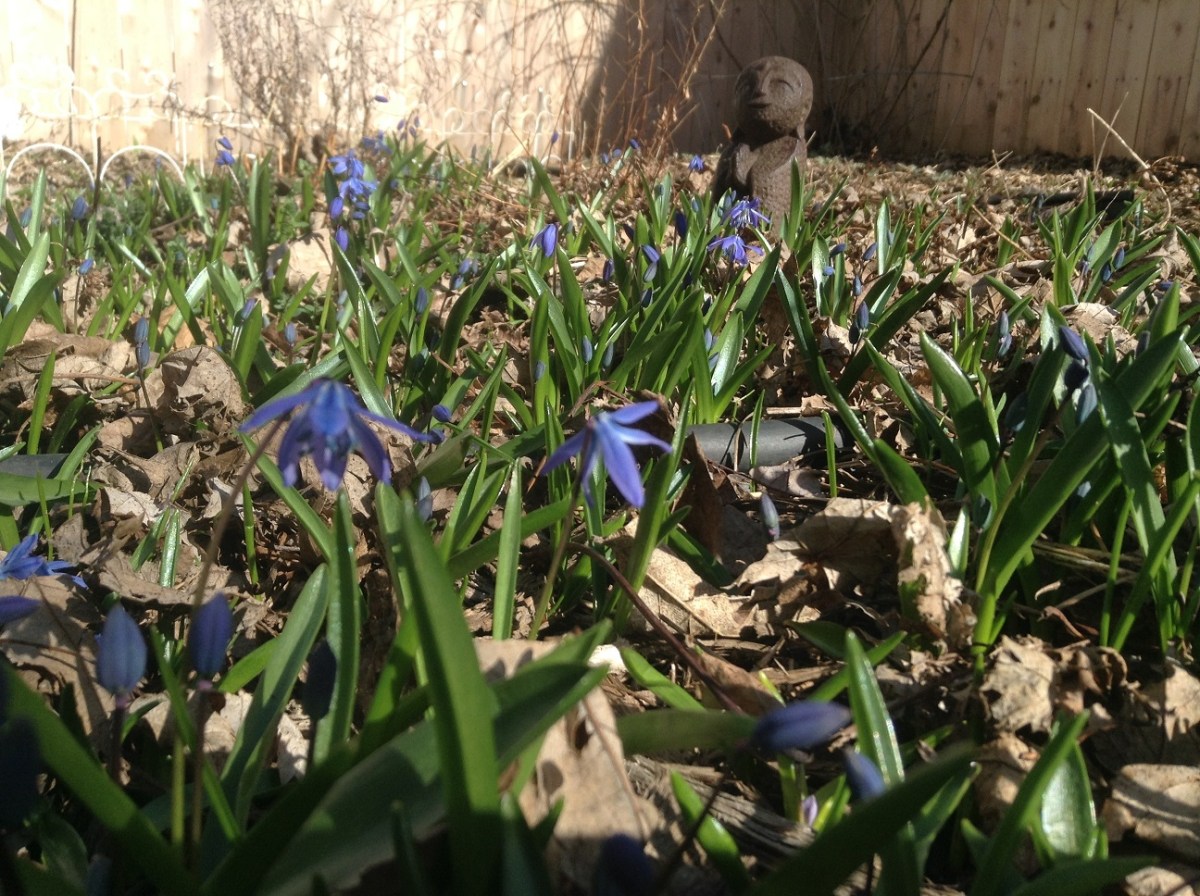
Spring is Coming

Spring is coming, is calling, is COMING!

Seeds, long held in the cozy dark, nutrient-rich soil, are beginning to push up through the darkness toward the light. Winter’s hold is not so tight.

The light is growing, is coming, is calling—don’t go back to sleep.

Feel your longing to wake up, deep down on the inside, like nature, longing to reach for the light.

Stay with the longing. Let it touch you. Let it move you into action. Let it keep you awake.

Breathe in the light all around you, in through all your pores, into your body—belly, heart, mind. Let is infuse and gently awaken and enliven you. Turn toward the light.

Spring Equinox in the Northern Hemisphere is officially marked on Monday, March 20th at 5:28 am Central Time, but we’ve been feeling its coming for some time now…

The last remnants of winter—the dark, the cold, the cuddled-up-in-bed parts—are holding pieces you need to release to be ready for Spring.

It could be anger, a hurt, an unrealized dream, a wish for life to be other than it is…Accepting that this, whatever it is, is still with you creates space for it to soften its grip and make way for the new energy of Spring, for a new beginning, a new seed to poke its way up through the dark underground into the light.

A Getting Ready Ritual

This ritual can support you in releasing what’s needed for Spring to arrive in your life. Enjoy it on the Equinox or before to prepare yourself for a new beginning any time.

  • Create intentional space for 20-30 minutes.
    • Turn off electronics, close the door, settle in for some undisturbed quiet time.
    • You might want your journal nearby.
    • You might want to light a candle or mark this time in some way.
  • In a comfortable seated position, breathe in earth energy through your feet, up through your legs, into your lower belly. Imagine, visualize, or physically sense this.
    • Breathe out and name whatever arises that you would like to release. As you exhale, soften, and simply let it be here with you.
    • Breathing in grounded, stable earth energy, and breathing out your desire to let this go, feeling and sensing whatever it is.
    • Inhaling earth energy up, then exhaling and naming what you would like to release, no forcing, no pushing away, no resisting.
  • Once you’ve accepted and allowed the feelings and sensations of what you’d like to release to be acknowledged, you’re ready to let them go.
  • Breathing earth energy in, let it go, carrying all you have released back down through your legs and feet into the earth, where it will be transformed.
    • Repeat this a few times.
  • When you are ready, begin your inhale the same way, but bring your breath all the way up to your heart.
    • On the exhale, if there is anything else arising in your heart that needs to be let go, name and release that.
    • Breathe this way a few times.
  • When you are ready, the same breath comes all the way up to the crown of your head.
    • And you release on your exhale, all the way down to the earth, naming anything else that arises, softening, softening, softening…
  • When you have run out of things to name, on your next earth inhale, as you breathe all the way up to the crown, name what you long for, what you are ready to move into, what you intend for yourself this spring.
    • Soften and let it all go, into the hands of life, returning it to the earth.
    • Continue breathing this way until you have named all that you long to bring into your world, all that you long to become this Spring.
  • Place your hands on your heart and make some gesture of gratitude.
  • Blow out the candle and/or close this intentional time in some way.

What is Spring inviting to grow in you?
What are you releasing to make space for this new growth?

Save

Everyday Love

It’s Valentine’s Day.

How about a focus on real,
everyday Love?


Romantic dinners, heart-shaped gifts, chocolate, sexy lingerie—they are a fun way of expressing Love, but I’m talking about taking steps to choose and create Love in a simple, daily way.

Today, can you remember to:

  • Give yourself the benefit of the doubt?
  • Be friendly and kind when you make a mistake?
  • Not rush?
  • Listen to the needs of your body? (move, rest, eat, use the bathroom…)
  • Listen to your heart, not judging your feelings, but allowing them all and being gentle with yourself?

With others, can you:

  • Be present with yourself as you interact with them? (That way you’ll be more attuned.)
  • Offer your kind attention, even to strangers?
  • Go out of your way to be of service?
  • Put yourself in their shoes before responding?
  • Receive their goodwill?

Everyday Love is a choice, an action, a verb.

Even if you don’t feel Love, take a step to choose it. Start with yourself and move out from there. Let everyone you touch receive your Love.

The world needs you, showing up as you,
which is an expression of Love.
And the world needs us all
choosing Love with each other,
one babystep at a time.

This is the way we can create Everyday Love, every day.

Come practice Everyday Love with me!

  • Body Love: Mindful Movement & Yoga, Tuesdays at noon
  • Body, Mind Love: The Mindful Art of Tea,Wednesday, February 15th
  • Body, Heart Love: The Way of the Happy Woman® Winter Mini-Retreat, Sunday, February 19th
  • Body, Heart, Mind Love: Mindful Self-Care for your Whole Bodysoul, Wednesday, March 15th
  • Body, Heart, Mind Love: Releasing Our Hearts: Working with the Passions and the Virtues of our Enneagram Type, with Dave Hall, Saturday, March 25th

Save

Save

Save

From Habit to Holy

We’re just over halfway through my free, online, 5-Day Practice Presence for Life Journey.

As we journey together, I continue to deepen my own inquiry into the connection between the ordinary and the sacred, between habit and ritual.

How is it that the same activity—getting out of bed in the morning, eating lunch, exercising—can be rote habit or sacred ritual?

The only thing that changes is what we bring to the activity. Every time we bring our mindful and kind attention to our actions, we are infusing that moment with presence and holiness. The holiness of intention and attention. The holiness of showing up to our lives as fully as we can. The holiness of simply being in and with our life.

By living with this respectful attention
and compassion moment to moment,
you sense the sacred in each part of your life.

~ Jack Kornfield in A Path with Heart, p. 197

Another aspect of creating sacred ritual vs. structured habit is that we consciously create the pattern we want to live in our lives. We take the time to consider what we need to make our lives more nourishing on all levels—more ease and wellbeing, more meaning and value, more [you fill it in…].

This can take a little effort to put into place. We have to take an honest look at what is not working and how we might change that. If I’m harried and arriving at work stressed out, maybe I need to create space for some morning practice. If I’m exhausted all day, maybe I need to figure out how to create resting and bedtime rituals. Or maybe I need to look at how I’m feeding myself or moving or something else, and how that is contributing to my overall wellbeing…

Making space for new ways of practicing is part of the picture. It might take a little creative thinking since we can get so locked in and attached to our unconscious habits. We have to be willing to experiment and try something new until we find the right fit for us.

Our patterns organize our reality.
They guide our established way of connecting with life.

~ Elaine de Beauport, Three Faces of Mind, p. 275

As we find the practices that work for us and create space for them in our day, we are setting the new pattern that can become sacred ritual. The familiarity of a repeated pattern provides us with a way to come back to ground, to give our nervous system deep rest. Our relaxed nervous system supports us on all levels so that we have more wellbeing in body, heart, mind, and soul. We are in rhythm with ourselves.

Ritual is an advanced routine, practiced
with care, attention, faith, and beauty.
It is a way of elaborating repetitive rhythms
ever more exquisitely, until they become ritual.

~ Elaine de Beauport, Three Faces of Mind, p. 301

Creating a life of everyday actions that become sacred ritual also means staying awake while we are practicing. As Kornfield emphasized, it’s the quality of our attention, not the doing of the new pattern that makes it sacred.

This is my challenge—I’m good at creating patterns, but then I have to remember to engage in them with presence, to bring all of me into my practice and not just practice to get it off my to-do list. (Yup, I have been known to fall into that one at times, even with a spiritual practice…)

And then there’s the trap of perfection, another one that has plagued me, especially as an Enneagram type One. I have often missed the sacred quality of presence in my patterns because I’ve put too much attention into doing them the “right” way. I am slowly learning that the only “right” way to practice is to show up—to bring as much awareness, heart, and embodiment to our practice as we can in each moment. That will vary day by day, moment by moment, and that’s OK!

We practice to nourish ourselves with our presence, not to try to reach some elusive ideal of perfection. Your presence matters. Your presence is what makes the moment, the practice, and your life holy.

Save

Save

Save

Come, yet again, come.

Come, come, whoever you are
Wanderer, worshiper, lover of leaving
Ours is no caravan of despair
Come, yet again, come.
~Rumi

It’s too easy to fall into ruts.

The brain likes patterns it can repeat. That frees up our energy for other things.

But what if some of our repeated patterns aren’t serving us–and yet they keep repeating on autoplay?

Come, yet again, come. This is a sweet invitation to come back to ourselves, to stop the autopilot of habit and wake up.

Wherever we are, whenever we notice, we have the chance to choose freshly again.


We can take a look at what we’ve been choosing.

When I’m not present, my type One orientation habitually and unconsciously chooses to try to improve things–me, you, my environment…life! I just have to learn a little more by reading one more article, to make the fridge look better by cleaning up that spill on the shelf, to bring order to the dining room by putting the Christmas wrapping supplies away…There’s always more to do and never enough time…Your way of getting lost may be very different from mine, but we all have them.

When we notice we are on autopilot, we can ask: Does what I’m habitually choosing reflect my values?

I often find my value for contemplative quiet time gets relegated to last on my list. Sure, I fit some in every morning, but if it’s something I truly value (and need to be well!) wouldn’t it make sense to create more space in my life for it?

Wanderer, worshiper, lover of leaving… Why do we wander away, leave what we value?

We forget.We get pulled back into the automatic pilot of repeating habits.

These are so compelling because they are familiar–the patterns have been traveled so often that they feel known, safe, comforting…even if we’d like to change them.

They don’t challenge our sense of who we might be, which might happen if we didn’t follow them. Our self-identity relies on them. In my example, I know myself as someone who is always making things better. This is an integral part of how I define myself, recognize my value, and orient to the world. Who would I be, how would I interact with life if I didn’t need to know myself in this way?

Holding what I am repeating on autopilot along with my values creates a paradox. How can both be true? And yet they are.

If we hold this paradox with mindfulness, we can receive the wisdom of right action. There is no ultimate “right” way to always respond, no one tried and true way to reconcile these opposites.

When I’m not present, I fall back into habit.

When I am present, I can hold both the habit and what I value, and see what arises as true in my experience right now, in this moment. Letting these guide me, holding the tension, and listening will result in the right action I seek. The next time I ask, the moment may require something else of me.

Come, yet again, come. Being present means I am responding freshly each time I wake up enough to come, yet again, back to myself and hold the paradox.

OK, your turn! What habits do you fall into without thinking? How do these fit with creating space for the things you value?

I look forward to journeying
with you!