with each step

“We can’t solve problems by using the same kind of thinking
we used when we created them.” ~ Einstein

Dave and I taught a daylong on the Law of Three, a deeply embedded teaching of the Enneagram, for our Minnesota Enneagram community this past Saturday.

The more I work with this teaching in my own life, the more I experience this truth—

When I’m stuck trying to solve something with my thinking, I don’t solve it by chewing over the same thoughts…

When I’m stuck in my feelings, re-experiencing them over and over again, they do not release…

There’s actually something valuable about that funny and famous cartoon (I paraphrase):

  • Patient: Doctor, when I move my leg like this, it hurts.
  • Doctor: Then don’t move it like that! 🙂

If we’re not running our habitual patterns to find an answer—overthinking, overfeeling, avoiding, denying, repressing, all of which cause us pain—what DO we do?

We apply what the Buddhists call skillful means.

Monday morning after my run, aware of a problem my mind and heart had not solved from the day before, I was practicing one of my favorite walking meditations from Thich Nhat Hanh:

The mind goes in a thousand directions.
The beautiful path is the path of peace.
With each step, a gentle wind blows.
With each step, a flower blooms.

This is an example of using skillful means—

When you’re stuck in your mind or heart, running the same old tapes…

Try coming back to the body.

As I walked this meditation, my senses came alive–with each step:

  • the gentle, cool breeze was blowing and kissing my face,
  • the flowers in yards and boulevards were blooming,
  • the trees were standing solid, tall, rooted, their leaves waving to me as I passed,
  • the sun filtered through the canopy, lighting up all it touched,
  • the moon, moving to half-waning, holding watch in the sky.

And my body came online, her intelligence sparkling, softening, supporting all that was trying to work itself out in my mind and heart.

No big “AHA,” but now, where there wasn’t before, there is space for something new to arise.

It can be this simple.

We can trust the intelligence of the body to support the heart and mind.

What body practices do you have in place to help you open to more spaciousness when you are stuck?

Save

Save

Season of Celebration and Regret

The light is changing and dark is coming faster in the eve and staying longer in the morn.

Once again, the trees are dropping their leaves, returning them to the ground.

Plants are flowering and fruiting, putting the last of their energy into ripening and celebrating, giving their all.


Autumn Equinox is Friday, September 22nd

at 3:02 pm CT,

marking this next pass through the seasonal rhythm that holds our lives.


I am experiencing sadness that summer and all its bounty is waning and gratefulness for the bright, crisp Fall days, colorful leaves, and invitation to turn inward. All accompanied by a sense that life is moving by so quickly!


The Jewish tradition has this Fall theme built into its yearly cycle.

September 21st marks the beginning of the Jewish New Year with Rosh Hashanah, the Days of Awe, and then Yom Kippur, the Day of Atonement, on September 30th.

There is joy for the opportunity to begin a new year combined with an inner examination of the past year and atonement for regrets in order to start the new year freshly, cleanly, returned home to God.


This is truly the season of Both/And,
of acknowledging all we have to celebrate
and all we have to regret.


Autumn invites us to use this changing of the seasons as a time to pause and assess our harvest.


What are you celebrating from the bounty of summertime?

What will you pick and savor and what will you let fall like leaves to the ground?

What needs to be cut back or released so that you can live your life
with more presence?

What did not turn out as you had hoped?

Do you need to repair any relationships—with yourself, others, or the Divine—
in order to return home?


For my part, when I look back, I see I have fallen again into piling my plate too full, and I regret that I didn’t make more time for what I call “right living,” living the daily rhythms of my life with less rushing and more connection.


I am letting go of a lot of things this the Fall to make space for slowing down to a rhythm that is more sustainable for living my life—workshops and events I wanted to attend, the poetry list I was sending out, preaching, music gigs, tea events I host, travel, even some teaching. I feel sad to not do these things that I love, and I so much look forward to the space I am opening up for more presence-full living.


There is always so much to hold in our lives—to celebrate and to regret.

Especially when we widen our gaze to include not only our individual lives, but the life of the earth, the life of our political environment, the lives of many who are suffering and many who do so much goodness in the world.


Sometimes finding our way to the goodness, the beauty, the wholeness, and the celebration is hampered by our inability to take a deep accounting of our actual lives. Aligning with this seasonal orientation, we need to acknowledge and work with the ways we are holding ourselves and others with unkindness so that we can recalibrate our lives and start fresh and clean again.


This usually invokes not only celebration but also a need for repair. Just as our Jewish friends are practicing atonement,

so our souls yearn for forgiveness,

of ourselves and of others—for harm we have done and harm we have suffered.


How about you? What regrets do you have that could be
eased by the soothing balm of forgiveness?


I’d love to support you this Autumn in recalibrating, repairing, and returning home to yourself with my new, 4-part series:

Save

Save

Save

Do Two Halves Make a Whole?

Apple pie and cheddar cheese.

Fear and courage.

Hungry and satisfied.

Independent and dependent.

Grief and compassion.

Utter lostness and presence.

Single and partnered.

Strength and helplessness.

Female and male.


Dualities. Opposites. Two halves of a whole.

I name them, breathe them, own them.

They are part of our human experience.

Without one, the other does not arise.


Often in relationship we see this clearly. If I hold down the pole of the kids keeping their room clean, you will hold down the opposite one—the kids should do what they want. If I say I want to work all day, you say, we’d better give ourselves enough time to rest and do other things…


It’s like we are covering the full spectrum of life in these dualities.


One complements the other. How could I really feel satisfied if I never felt hungry? Without being lost, how would I feel my presence? How could I really enjoy my apple pie for breakfast without a good hunk of cheddar cheese? 😊 (Thanks, mom!)


Diamond Approach teacher AH Almaas takes it a step further and says that the qualities of our Essence arise as needed.

It’s not that we just don’t feel the pole without its opposite. An Essential Quality like Compassion has no need to arise unless a state of suffering like grief or fear or shame calls for it. Strength only arises when needed—when I’m feeling helpless, weak, unconfident, etc.

One is not “good” and the other “bad.”

That’s just another duality—each side of the equation keeping the other alive…


The old saying “Two halves make a whole” has some relevance here.

My mom used to emphasize that in relationship, that saying is not true—if we come to each other as halves, we won’t find wholeness. We each need to be whole in ourselves first.

This also applies in looking at life through the lens of duality. If I get caught up in juxtaposing the halves, the good-bad, strong-weak, independent-dependent, happy-sad, etc., I am not living into the wholeness that is possible.

Holding each pole of the duality, welcoming it, getting to know it, and not grasping, but opening ourselves (heart, body, and mind) allows something new, fresh, and essential to arise.

How do you work with duality in your life?


Dave & I are teaching a full-day workshop about this:


And I will be teaching a 4-week series on Forgiveness, which I have found is a HUGE part of being able to open to the innate wholeness, too:

Unfolding the Heart: The Journey of Forgiveness

We hope you will join us!

365 self-care!

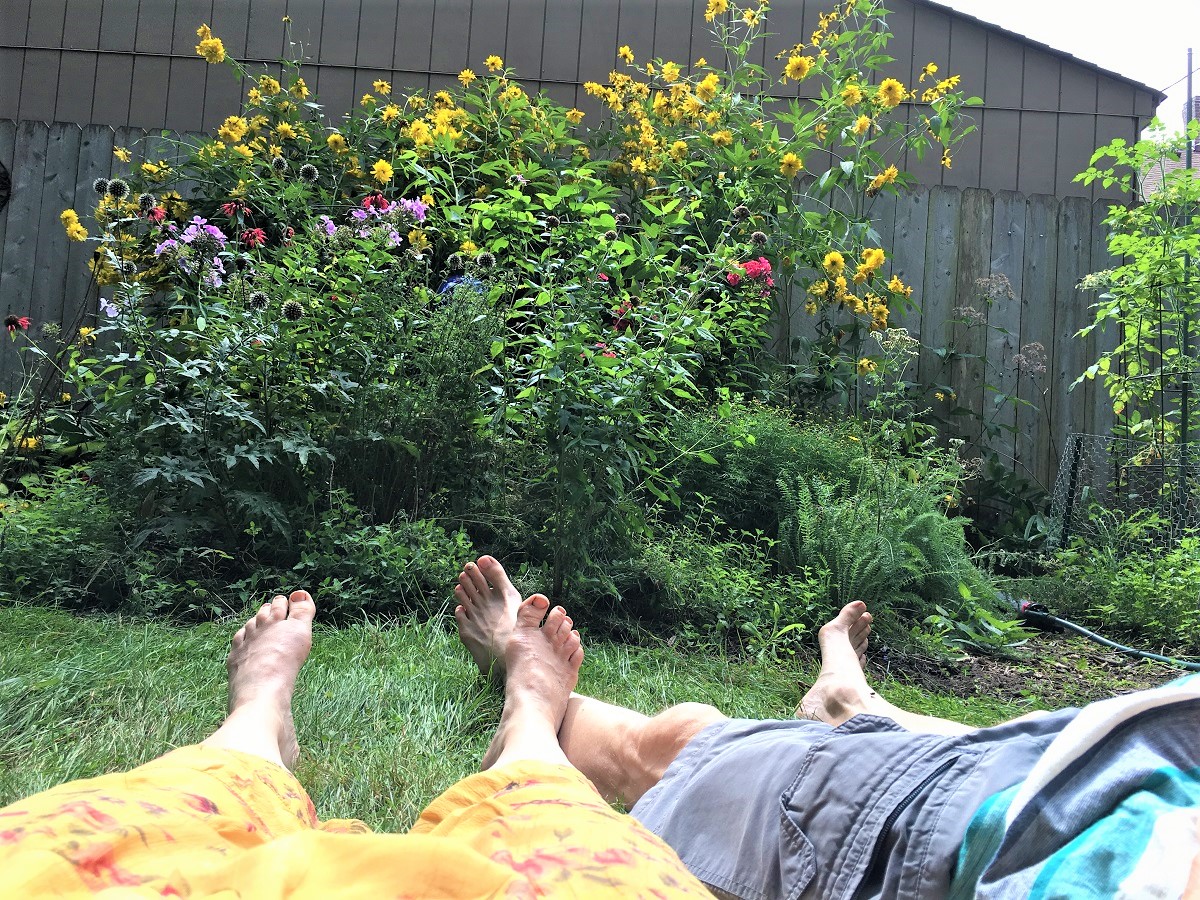
Does lying in the backyard together watching the total solar eclipse count?

How about making sure I get some veggies in at every meal?

What about dancing wildly to feel my juicy aliveness?

Yes. It all counts.


Self-care is about listening to what your bodysoul (body, heart, mind, soul) really needs in any moment to be truly well.


Because of the way we’re programmed (or if we’re in an extreme circumstance of some sort), we can get kinda stuck on one track of self-care.

If my self-care is just about physical body stuff—enough sleep, healthy food, taking my supplements, exercising—it’s not enough.


SAY  WHAT?


Yes, I stand by it!

Self-care is bigger than just taking care of your body’s self-preservation needs of what I call grounding and nesting!

We also have to consider our need to feel a sense of belonging and place (connecting), and our need to feel pleasure and turn-on (aliveness / radiance).

All three forms of self-care are innate, animal, instinctual needs that operate under the surface all the time.

Especially when we’re stressed, we pay A LOT Of attention to trying to get at least one of these needs met…


Which one do you habitually and perhaps subconsciously prioritize? (I focus most on my grounding / nesting needs.)

What are you neglecting? (I’ve had to learn to pay attention to my aliveness / radiance needs.)

I’m writing about this in my book Nourishing the Feminine, and I’ll also be teaching about it at my:


Looking forward to supporting you in your self-care needs–in whatever form that takes–classes, retreats, tea, coaching, connecting!

Save

Save

Save

and there is only the dance

We begin in the name of Allah.
Alleluia, Lord have mercy, Christ have mercy.
There is no God but God.
Sacred, Holy, Heaven here on earth.

Just four of the many chants/dances we began with our first night of the Dances of Universal Peace retreat with Sufi teacher Maitreya this past weekend.

We sway, bow, pray, sing, open…

Holding hands with our neighbors…

  • stepping into the center, lifting our hands and hearts and minds to the Divine,
  • bowing to each other, to True Nature within, to ourselves,
  • collecting the mercy and grace in our cupped hands and letting it pour down like rain, blessing us head to toe.

Maitreya reminds us over and over that we are already enlightened.

There are obstructions to this light, but it is already within. We dance to remind ourselves, to reconnect to this light within, among, and beyond us.

The rhythm of the simple chants and steps entrains the bodysoul.

Step, bow, turn, spin.

Forward & backward, surrender, change course, turn inward & outward.

 Again. Again. Again. Again.


Perfection in the repetition, in the fullness of the unifying rhythms of body, heart, mind, and soul.

This is embodied group spiritual practice, joining hands, hearts, and voices together to weave the fabric of Love.

How do you embody your spiritual practice?

Join me for another, perhaps more accessible-in-daily-life, form of embodied spiritual practice: Healthy High Tea in the garden, in which we mindfully nourish our bodies, hearts, minds, and souls with real food and good company.

Save

Savoring Dave, Chocolate & Summer!

something different: a little, rhyming summer poem for you!

🙂

Even though we rarely eat sweets,

Dave’s 60th needed a

treat.

Something summery, simple, and

celebratory

to follow salmon, salad, memories, and stories.

The family in the garden all gathered together,

sipping and supping with laughter and

pleasure.

The chocolate pots cooled to luscious perfection,

We savored each spoonful of blissful confection!

chocolate pot 1200x

To taste these Chocolate Potstry the recipe!

How are you savoring these precious days of Summer?

Building Temples of Forgiveness

This is the final post in a 3-part series on Unfolding the Heart.
Find the first post here.

Let’s take this a little deeper.

Let’s look for the innocence.

This was a hard one for me in the forgiveness work I’ve been engaged in over the past year.

To protect others and not cause more harm, I’ll give you the general outlines to describe what I’ve been working with:

I worked for a spiritual organization for 14 years and when I decided to leave due to integrity issues last year, they didn’t pay me the $5,800 in back vacation pay and consulting fees they owed me. They said they only way I could be paid was to sign away that 14 years of my life—to never publicly claim I had worked there. And to top it off, they still won’t talk with me and tell me why. I went from being the most valued employee to this.***

For the first half-year, all I could do was suffer.

  • I judged them as wrong and bad and lived in fear.
  • I went over and over the situation in my mind to try to make sense of it and see my part, learn my lessons…
  • I mostly saw their guilt and wrongdoing. 😦

Then I found some work to help me with the F-Word, forgiveness.

And I saw how I was keeping my own suffering going by splitting off and separating myself from them:

  • I was good one, the wronged-one, the victim.
  • They were the bad ones, the wrong-ers, the perpetrators.
  • End. Of. Story.

As you can imagine, this view was not helping me find freedom or a way to move forward in my life!

So I decided to look for their innocence—and I found it.

I saw how they were not doing this to me on purpose. They were living out their own separation and splitting, their own fear, their own attempt to be happy. I just happened to be affected by the wake of their huge ocean waves.

When I looked deeper, I could imagine the suffering underneath their actions, what might be causing them to treat me this way…

And over time, my heart unfolded, becoming bigger and wider and more available to Love.

Do I agree with their actions? No.

But I no longer judge them as bad or wrong because I can see underneath the rocky waves to the ocean of Oneness that connects us:

  • the ocean of innocence,
  • the ocean of groundlessness,
  • the ocean of Love.

And I invite you to do the same.

Whether you are working with forgiving yourself or an “other,” you can always look for the innocence underneath the actions.

You can see that underneath it all, there is an innocent, small childlike place that is just trying to be happy, to feel OK, even to survive.

peony-white-beginning 1200x

We can’t force anything. We can’t force our hearts or the heart of the “other” to unfold. It has its own timing and process of growth.

But we can look for the innocence. And notice how our body, heart, and mind respond.

Make this practice your own. Forgiveness is usually a long process, and it can’t be rushed.

I found that I needed to fully feel my own suffering before I was willing to see their suffering and innocence.

And after that, I needed to keep turning my perspective toward innocence, toward a willingness to see with fresh eyes. Every time the feeling of being wronged arose, I tried to reorient to the Oneness with an intention or prayer.

May I see their innocence.
Open my mind to a deeper truth.
I am willing to see Love. Show me.

I let my heart yearn for this opening.

Research shows that those who practice forgiveness—and it is a lifelong practice—are healthier and happier.

In one Stanford University experiment, people reported fewer backaches, headaches, muscle pains, stomach upsets, and other common physical signs of stress. They also reported higher levels of optimism, hope, and self-confidence.

In a study at University College of London, they found that those who didn’t practice forgiveness suffer from a 55% higher risk of serious heart disease.

The negative emotions of injustice, anger, bitterness, vengeance, unfairness, and more cause biochemical changes in your body that damage your physical health.

And setting the physical health risks aside, who wants to live in the constant state of negativity that unforgiveness creates?

Contrary to popular belief, we are not stuck here just because something “bad” happened that we had little or no control over. We have a choice—a choice to do our own work and practice forgiveness, over and over and over again.

Forgiveness is an act of the heart, a movement to let go of the pain, the resentment, the outrage.

And as Buddhist teacher Jack Kornfield says so simply: Letting go begins with letting be.

That’s why the first step is to stay with our suffering—we let it be, we acknowledge it, we allow it, without judging, but with gentle holding and compassion. (You can read more on that in the 2nd part of this series.)

By opening to the pain we are trying to push away, we clear a space for something new, fresh, and alive to awaken in our hearts, for a return to Love.

Forgiveness is about accepting what happened (letting it be) and finding a way to release it so that you can live now, regardless of what happened in the past.

  • It’s about releasing the attempt to control the outcome and letting your heart and your life unfold in the present.
  • It’s about allowing healing without knowing or controlling how that will happen or look.
  • It’s a return to an open body, heart, and mind, softened by the healing power of Love.
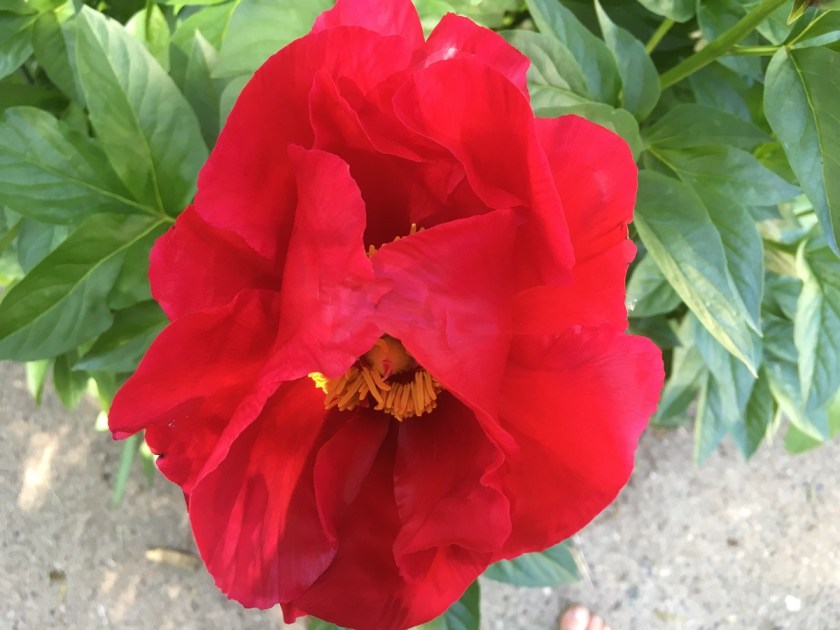
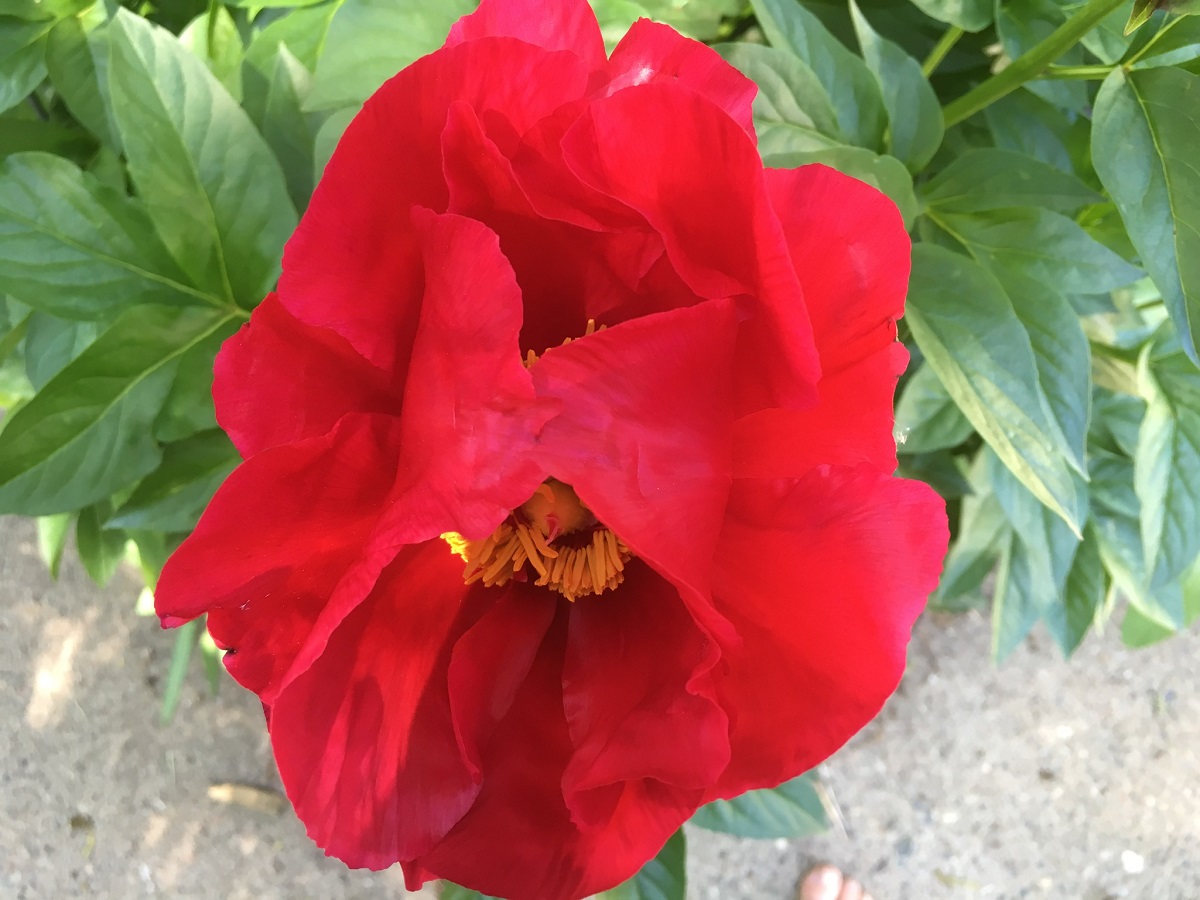
red peony partially closed-1200x

One last practice, this one from Rob Eller-Isaacs, one of our ministers at Unity Church Unitarian in St. Paul, Minnesota.

I invite you to close your eyes again and bring your grievance to mind, heart, and body once more.

  • Think about it, and then sense and feel how it affects you.
  • Let these things be as they are, without trying to change them, opening to the truth of your feelings and sensations in the moment.
  • If you have a sense of your or the other’s innocence, bring that to body, heart, and mind—if not, no worries.

Now place one hand on your Heart Center and one on your Belly Center, below your belly button. Let them be kind, loving, allowing hands. Accepting you just as you are, like a loving mother would.

And repeat silently:

  • I forgive myself.
  • I forgive you. (Perhaps this is said to a part of yourself.)
  • We begin again in Love.
  • [Repeat this 3x]

And say it once outloud as if we were saying it all together, to feel the solidarity and possibility in this common intention for our lives:

  • I forgive myself.
  • I forgive you.
  • We begin again in Love.

I end with a quote from Jack Kornfield that encourages us to take on the sacred work of forgiveness:

If only we could help each other build temples of forgiveness
instead of prisons. We can. In our own hearts.

** Jack Kornfield quotes from The Art of Forgiveness, Lovingkindness, and Peace

*** Note: On August 8th, 2017, I received financial payment in full without having to sign my affiliation away, after over a year of spiritual work on my own. (With support of friends and teachers!) It happened after I had fully released any expectation of payment and had focused on my own work and ways I could make amends.

Save

Beyond Rightdoing and Wrongdoing

This is the 2nd of a 3-part series. Read the first.

Just choose Love over Fear!

Love forgives. Fear blames and holds grudges.

Not so fast.

This may be true. In fact, I know it is, but for most of us it’s not that simple. The truth is:

Love is able to hold the deeper view of non-separation,
so there is no-one to blame and hold a grudge against.

Our ego personality can’t see this. We see ourselves as separate beings that things are done to.

  • The separate being of me does something to the separate being of you that causes harm in some way.
  • Or vice versa.

But what if this view is a wrong-minded perception as A Course in Miracles would say?

What if it’s really true that at our core, all is One, as all faith traditions I’ve come across affirm.

It’s true that this Oneness is housed in separate bodies. There’s no denying that we look different on the outside.

But the core of reality is consistently described as a Oneness from which all things arise.

The metaphor of the ocean helps me understand this.

  • I think we can pretty easily see how the water in the ocean is one water, right?
  • And yet the waves take many different forms.
  • And drops of water take shapes, too—droplets, spray, some bigger or smaller…
  • And the bottom of the ocean might be completely still and calm while a storm is raging above.
  • It’s all the same ocean, all the same water… all the same Oneness.

If we accept this as true, then when our separate egos do things that consciously or unconsciously cause harm, what are we harming?

Our ego personalities? They are part of the Oneness, too.

Any harm done by or to us affects us and the other. We are completely connected underneath the surface waves, just like the water.

From this perspective, Oneness or you could call it Life / God / Goddess / True Nature / Being is unfolding through us:

  • Through our actions.
  • Through our minds and hearts.
  • And all the harm done by or to us is part of this unfolding.

YIKES!

This goes directly against our very human desire to know what is right or good and to make sure we are on the right side of it.

We want to be good people. We want to know who has done something wrong and do something about it.

But what if there is no Good or Bad?

  • What if our trying to make situations fit into good / bad, right / wrong is really just an attempt by our dualistic mind to know where we stand, to understand the world, to feel a sense of security and stability?
  • What if it’s a wrong-minded perception that causes us to miss the Oneness?

Buddhist nun Pema Chodron, in her book When Things Fall Apart, says:

The whole right and wrong business closes us down and makes our world smaller.
Wanting situations and relationships to be solid, permanent, and graspable
obscures the pith of the matter, which is that things are fundamentally groundless.

This can feel very scary. All of a sudden, it’s not so clear how to determine if I’m a Good person anymore.

  • If I can’t make the other who has hurt me Bad, how do I know I am Good?
  • Doesn’t practicing the Good F-Word make me a Good person?

If everything is part of the Oneness, there is no Good vs. Bad.

  • Why would the Oneness split off parts of itself?
  • Doesn’t it express through everything, in all forms?

As Pema continues:

Whether it’s ourselves, our lovers, bosses, children, local Scrooge, or the political situation,
it’s more daring and real not to shut anyone out of our hearts
and not to make the other into an enemy.

We learned really early on how to be good from our parents, our culture, our personality, our religion… and it got internalized by our inner critic that lets us know whenever we stray by judging us from the inside to get us back on the straight and narrow.

But does this splitting of good / bad, right / wrong serve us?

  • Does it make you happy to separate yourself as over here and look at others as over there?
  • Does it make you happy when your inner critic judges you as doing something wrong?
  • Does it make you happy when you judge others as wrong, bad, immoral, ignorant, corrupt?

I doubt it.

It might whip you into action, but what is that action motivated by?

Probably not love. Or Oneness.

And we know that even social justice from that place can become tainted and unloving—without awareness of the Oneness, it can only hold a slice of the truth.

Pema suggests we “contemplate the fact that there is a larger alternative to [making ourselves right or wrong], a more tender, shaky kind of place where we could live.”

Practice Time!

I invite you to bring to mind a circumstance in which you are having a hard time forgiving yourself or someone else.

  • Close your eyes and give yourself to thinking about it.
    • Ideally something up close and personal.
    • But if you’re having a hard time coming up with something, try choosing a part of our current political situation.
  • Notice your thoughts: the judging, the blame, the anger, the outrage. All of it.
  • Now bring your awareness to your heart and body.
    • How are you feeling? See if you can name 2-3 feelings. If you’re not sure, look for hurt, anger, resentment, grief…
    • What’s going on in your body? How is your body reflecting this suffering?
      • Scan for places of tension, numbness, rigidity, clenching…
      • Of collapse, shoulders rounding in to protect your heart, slouching, lack of energy…
      • Or anything else…
  • If you’re willing, place your hand on the center of your chest, on your heart center.
  • What if all this suffering is not good / bad, right / wrong?
    • What if it just is? It is your very human response to trying to make sense of something really hard.
  • Can you be with that, accept that, without needing to separate yourself or find a sense of solidity by being the good or the bad one?
  • What if it’s the Oneness of life expressing through you and this other? For some reason that you do or don’t understand.
    • For your growth, for the other’s growth, for our world’s waking up.
  • Can you stay with the pain, the soft vulnerability of that without splitting?
  • Can you stay with this groundless place of the ever-changing flow of life and your place in that flow?
  • Can you find a place of refuge in this open, soft moment of willingness?
  • Thank you.

Our egos, in an attempt to find happiness, do things that cause real pain to ourselves and others.

Suffering happens when we resist and don’t accept what is happening. Responding from suffering creates more suffering. It solidifies the right / wrong position and sets us up to judge ourselves and others.

We don’t need suffering to get life done, to take right action, to work for social justice.

For that, we need Love. Only Love will soften our hearts and clear our minds to truly guide us into right action.

As Rumi says, “Out beyond ideas of wrongdoing and rightdoing, there is a field. I’ll meet you there.”

I’d love to know–How is this landing for you?

Read the 3rd in this 3-part series.

The F-Word

This is the 1st of a 3-part series. Read the 2nd here.

The F-Word.

As a born-again Christian (and an Enneagram type One), this word was totally off limits. It was a BAD word. Only BAD people used it.

And I, of course, did not want to be BAD.

I was working really hard to be GOOD, with a Capital G.

But the F-Word held a certain power, a mystique, a “je ne sais quoi.”

After that teenage phase of my life, it slowly found its way into my expression, for better or for worse.

These days, I’m much more interested in the other F-Word.

I bet you know it, but maybe not by this moniker, which I learned from Gabrielle Bernstein.

It actually has many similarities to that first F-Word I mentioned–

It holds great power…

  • To open new pathways in our being,
  • To affect relationships between people,
  • To make a huge impact on communities, our culture, and the world.

Its mystique is well-chronicled…

  • Demons lose their power,
  • Stuckness mysteriously disappears,
  • The heart unfolds.

So, what is this F-Word?

Maybe you have guessed it by now?

Forgiveness

I know, it’s a doozy!

We’ll break it down little by little in this series of blogposts, but for now, let’s end with this:

For-Give, Etymology:

  • from Old English: for + gifan = to give
  • from Old German: vergeben
  • from perdonare, Latin = to give completely without reservation.

To give completely without reservation

Without losing yourself–

  • Without giving up,
  • Without giving in,
  • Without giving over,
  • Without compromising your values,
  • Without condoning what was done to you or by you.

This requires a soft and open heart, mind, body, and soul.

Read the 2nd of this 3-part series.

And in the meantime, I’d LOVE to hear your thoughts thus far!

Save

Save

Bowing Practice

I’ve been practicing bowing recently.

When I was researching possible publishers for the book I’m working on, I stumbled upon a book called Bowing by Dahn Yoga Education. I was intrigued and ordered it.

When it came, I devoured it in one sitting and started practicing!

It’s a simple practice, bowing.

Just like the tulips in the photo, that rise in the spring, bloom radiantly, and then release their form to the earth to build up energy for their next blossoming in the following year, bowing is a metaphor for being willing to let go, and then re-form and rise again…when it’s time.

Hands at my heart, I feel myself here, human, woman, being, connecting earth and heaven.

Prayers reach to heaven, draw down into my earthly body, mix the light and dark, the active and still, the blossoming and the release of this form.

And then the downward trajectory, bodysoul (body-heart-mind-soul) returning to the earth with reverence and humility, a sacred return.

How surely gravity’s law, / strong as an ocean current, / takes hold of even the strongest thing /
and pulls it toward the heart of the world.
 (Rilke in II, 16.)

Ashes to ashes, dust to dust, growing from the earth, returning to the earth. Head bowed, touching the earth, hands open to receive.

If we surrendered / to earth’s intelligence /
we could rise up rooted, like trees.
 (Rilke in II, 16.)

Surrendering this moment through the physicality of the bow. My body embodying it so that my heart and mind can learn this gesture as well.

…to fall, / patiently to trust our heaviness. / Even a bird has to do that /
before he can fly.
 (Rilke in II, 16.)

Returning to standing, following the same pathway, with a subtly changed orientation of the heart. Bringing the humble, solid, ever-supportive and accepting presence of earth up into my humanness, connecting heaven and earth.

 How does practicing the bow feel to you?